
The ADHD Morning Checklist That Finally Stopped Our School Meltdowns (Free Printable)
It is 7:43 a.m. Your child is still in pajamas, the backpack is missing a folder, and someone is crying — possibly you. If ADHD mornings in your house feel like a daily emergency, you are not doing it wrong. The ADHD brain genuinely struggles with sequencing, transitions, and time awareness, and mornings demand all three at once.
This article walks you through a step-by-step ADHD morning routine checklist for kids that many families find makes a real difference. You will see the reason behind each step, so the checklist actually makes sense to you — and to your child.
If you want something to start with right now, I put together 7 free printable routine sheets that go with this system — grab them here

Why ADHD Mornings Fall Apart in the First Place
Most parents assume the problem is motivation. Their child just does not want to get ready. But the real issue is usually executive function — the brain's ability to plan, start tasks, switch between them, and track time.
For a child with ADHD, "get ready for school" is not one task. It is about fifteen tasks strung together with invisible thread. Without external support, that thread snaps somewhere between breakfast and finding two matching shoes.
Understanding this shifts the whole conversation. You are not fighting defiance. You are compensating for a skill gap — and a checklist is one of the most practical tools that can help.
Step 1: Wake Up With a Buffer (Not a Scramble)
Build in ten to fifteen extra minutes beyond what you think you need. ADHD kids almost always take longer than expected on every single transition, and without a buffer, you are already behind before the day starts.
Set a consistent wake-up time, even on weekends when you can manage it. Many families find that a predictable rhythm reduces morning resistance significantly over time.
Real example: Maya's mom used to wake her at 7:15 for a 7:50 bus. Mornings were a disaster. She moved wake-up to 7:00 and added a two-minute "wake-up song" to signal the start of the routine. Within two weeks, the yelling dropped noticeably.
Step 2: Post the Checklist at Eye Level — Literally
The checklist only works if your child can see it without searching for it. Tape the Morning Checklist to the bathroom mirror or the back of their bedroom door — somewhere they will encounter it automatically, not somewhere you have to tell them to go look.
Visual cues can support ADHD kids in ways that verbal reminders often cannot. When you say "go brush your teeth," your child has to hold that instruction in working memory while their brain is already pulling in five other directions. A posted checklist offloads that mental work to the wall.
This small placement detail is one of the most underrated parts of making any visual schedule work for a child with ADHD.
Step 3: Use Pictures for Younger Kids (5–7 Years Old)
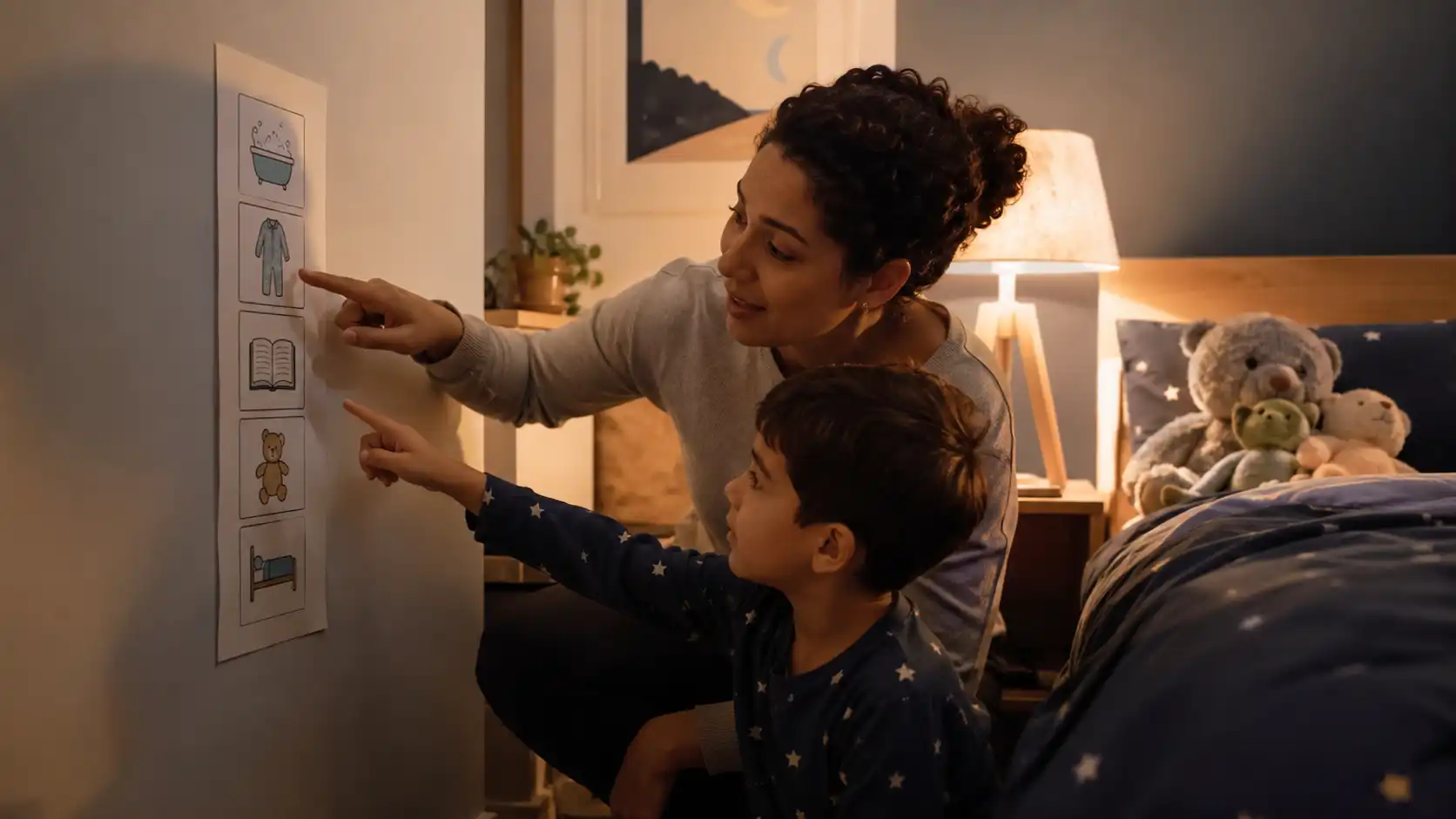
If your child is five, six, or seven, written words on a checklist may not be enough. Picture-based steps are far easier for young ADHD kids to process independently.
The Getting Ready Cards were designed exactly for this age group — each card shows one step with a clear image, so your child can move through the sequence without needing you to narrate every transition.
When building or choosing a visual schedule for your ADHD child, keep these in mind:
- Use real photographs or simple, clear illustrations
- Keep one task per card or row — no combining steps
- Arrange cards vertically so the sequence reads top to bottom
- Let your child check off or flip each card when done
- Laminate if you can, so you can reuse them daily
Step 4: Break Breakfast Into Its Own Mini-Routine
"Eat breakfast" sounds simple. For an ADHD child, it involves sitting down, staying seated, not getting distracted by the dog or a stray LEGO, finishing the food, and then transitioning away from the table — all before 7:30 a.m.
Reduce the decision load here. Keep breakfast options to two or three choices your child can rotate through. Prepare what you can the night before. If your child tends to stall at the table, a visual timer they can see may help them understand that breakfast time has an endpoint.
Many families find that keeping breakfast predictable and low-drama is one of the fastest ways to improve the overall morning tone.
Step 5: Tackle the Backpack the Night Before
This one step alone can cut five to ten minutes of morning chaos. When you move backpack prep to the evening, you remove it from a window of time when everyone is rushed, dysregulated, and running late.
The Backpack Checklist gives your child a concrete list of what needs to go in the bag before it gets zipped up for the night. Many families hang it inside the closet door or right above where the backpack lives.
This is exactly the kind of sheet included in the [free routine pack](https://klivanta.com/free-routine-sheets/7-adhd-daily-routine-sheets.html) — print it once and keep it on the fridge or near the homework station.
Real example: One dad shared that his son would regularly forget his lunch, his homework folder, or his PE shoes. They started doing a two-minute backpack check after dinner using the printed checklist. In a month, the forgotten-item calls to school dropped from several times a week to almost never.

Step 6: Build In a Clear "Done" Moment With Rewards
ADHD kids often struggle to feel the satisfaction of finishing something, because the finish line is abstract. Create a concrete "done" moment that your child can see coming and look forward to.
The Morning Reward Card can help here. Your child earns a simple, visible reward — a sticker, a checkmark toward screen time, a small privilege — for completing the morning routine independently. The reward does not have to be big. It has to be consistent and immediate.
Here is what can make a reward system stick:
- Keep the reward simple enough to deliver every single morning
- Give it immediately when the routine is done — not at the end of the day
- Let your child choose the reward from a short list you approve
- Celebrate partial wins early on, especially in the first two weeks
- Reset without shame if a morning goes sideways
Step 7: Use a Visual Timer for Time-Blind Kids
Time blindness is one of the most commonly overlooked challenges of ADHD. Your child is not ignoring you when you say "five more minutes." They genuinely cannot feel that five minutes passing.
A visual timer — one that shows time disappearing as a colored arc or bar — makes time concrete instead of invisible. Many families find that placing a timer in the bathroom during teeth-brushing or in the bedroom during dressing can support kids in ways that counting down verbally simply does not.
You do not need an expensive gadget. A simple kitchen timer with a visual display works. The key is that your child can see time moving on their own, without needing you to narrate it.
Step 8: Do a Calm Final Check at the Door
Before anyone puts on shoes, do a thirty-second door check together. This is not a panic scan — it is a quiet, predictable habit. You ask the same two or three questions every morning:
- "Do you have your backpack?"
- "Do you have your lunch?"
- "Do you have your [insert what gets forgotten most]?"
This moment can also serve as a regulation check-in. A quick "how are you feeling?" gives your child a chance to flag anxiety before it explodes at the bus stop. Many families find this thirty-second pause actually saves time overall by catching problems early.
Keep it brief, keep it consistent, and keep it calm — your tone sets the emotional temperature for the exit.
Step 9: Audit the Routine Every Few Weeks
No routine stays effective forever, especially with kids who are growing, changing schools, or hitting new developmental stages. What worked in September may not work in January.
Set a reminder to check in with yourself and your child every three to four weeks. Ask what is working, what is causing friction, and whether the checklist still matches your actual morning. Tweak one thing at a time so you can tell what actually helped.
Routine building with an ADHD child is not a one-time fix. It is an ongoing process of noticing, adjusting, and trying again — and that is completely normal.
Quick Action Plan
Here are four things you can do today to put this system in motion.
- Print the Morning Checklist and the Backpack Checklist tonight, not tomorrow. Set them out where your child will see them first thing.
- Move backpack prep to after dinner. Do the first backpack check together so your child knows what the list means.
- Pick one consistent wake-up time and set two alarms — one for you, one for your child.
- Choose one simple, daily reward your child can earn for completing the morning routine. Write it on the Morning Reward Card and put it on the fridge tonight.
- Find a visual timer you already own — a kitchen timer, a phone app, anything with a visible countdown — and put it in the spot where your child stalls most.
- Tell your child what you are changing and why: "We are going to try something new to make mornings feel better for both of us." Buy-in matters, even at age five.

FrequentlyAsked Questions
What should be on an ADHD morning checklist for kids?
A strong ADHD morning routine checklist for kids covers the full sequence from wake-up to walking out the door: getting dressed, eating breakfast, brushing teeth and hair, packing the backpack, and the final door check. For younger children, picture-based versions of each step may work better than written words. The key is keeping each item specific — "put on shirt, pants, socks, shoes" rather than just "get dressed."
How do I get my ADHD child ready for school without yelling?
The goal is to shift from verbal reminders — which require your child to hold instructions in working memory — to visual systems your child can follow independently. A posted checklist, a visual timer, and a predictable sequence can reduce the back-and-forth that leads to escalation. Many families find that fewer words from them and more structure in the environment is the combination that finally works.
What is a good morning routine for a 5-year-old with ADHD?
At five, picture-based routines work best. Use image cards for each step, keep the routine to five or six steps maximum, and build in a small reward at the end. The routine should be short enough that your child can complete it before their attention shifts. Evening prep — laying out clothes, packing the bag — removes several steps from the morning entirely, which can help significantly at this age.
Why does my ADHD child have meltdowns every morning even when we have a routine?
Even with a routine in place, ADHD kids can melt down due to transitions, unexpected changes, sleep issues, or anxiety about the school day itself. A routine reduces the frequency and intensity of meltdowns but may not eliminate them completely. If meltdowns are frequent and severe, it may help to talk with your child's pediatrician or a therapist who works with ADHD kids, as there may be additional supports worth exploring.
Want the Free Printables That Go With This?Everything in this article — the morning steps, the backpack check, the reward card — is easier when you have something you can actually print and put on the wall today. You can grab all 7 free printable routine sheets right here: 7 Free Printable ADHD Daily Routine Sheets. No signup hoops — just download and print.If you want the full system with every tool in one place, The ADHD Parent Toolkit at klivanta.com has everything families need to build routines that actually hold. |
|---|


Leave a Comment