
Why Your ADHD Child Can't Fall Asleep (And the Bedtime Routine That Actually Works)
You have done everything the sleep articles told you to do. Earlier bedtime, no screens, warm bath, consistent schedule. And your child is still bouncing off the walls at 9:30 p.m. while you sit outside their door exhausted and quietly wondering what you are doing wrong.
You are not doing anything wrong. The problem is that most bedtime advice was not written with your child's brain in mind.
This article explains exactly why the ADHD brain resists sleep at a biological level — and then builds a step-by-step evening routine directly around those obstacles. Not a checklist of obvious tips. A real fix, starting tonight.

The ADHD Brain Does Not Know It Is Tired
Here is something most sleep guides skip entirely: children with ADHD often have a delayed circadian rhythm. Their brains release melatonin — the hormone that signals "time to wind down" — up to two hours later than neurotypical kids the same age.
That means when you are trying to get your eight-year-old into bed at 8:30 p.m., their brain genuinely has not received the biological signal to sleep yet. They are not being defiant. They are not manipulating you. Their nervous system is simply not ready.
This is called delayed sleep phase, and research suggests it affects a significant portion of children with ADHD. Understanding this one fact can completely change how you interpret the bedtime battle — and how you approach it.
Why "Just Calm Down" Does Not Work
The ADHD brain has a harder time regulating its own arousal level. Think of it like a dial that gets stuck on high. Even when your child is physically tired, their brain may still be running at full speed, cycling through thoughts, replaying conversations, or fixating on tomorrow's excitement.
This is not a willpower problem. It is an executive function problem. The prefrontal cortex — the part of the brain responsible for shifting gears and transitioning between states — works differently in kids with ADHD.
Telling a dysregulated child to "settle down" is like telling someone to manually slow their own heartbeat. The instruction does not match the capability.
What actually helps is building an external structure that does the regulating for them — a routine their environment manages so their brain does not have to.
Transitions Are the Hidden Enemy
For many ADHD kids, the biggest problem is not sleep itself. It is the transition to sleep.
Moving from an engaging activity — a video game, a conversation, a book — to the dimly lit quiet of a bedroom requires a significant mental gear shift. ADHD brains are notoriously poor at stopping one thing and starting another, especially when the thing they are stopping is stimulating and the thing they are starting feels boring or uncertain.
Real example: Maya, age seven, had no trouble falling asleep once she was in bed. Her problem was the 45 minutes of screaming, bargaining, and crying that happened between the couch and the pillow. Her parents realized the battle was never about sleep — it was about stopping what she was doing. Once they added a clear transition warning system, the nightly meltdown dropped by half within two weeks.
Transition resistance is predictable, which means it is also preventable. The key is giving the brain enough runway to shift states gradually rather than demanding an abrupt stop.
Why Screens Make This Twice as Hard
You probably already know screens before bed are not ideal. But with ADHD, the problem goes beyond blue light.
Screens — especially interactive ones like games or social videos — are engineered to be maximally stimulating. For a brain that already struggles to downregulate, that kind of input does not just delay sleep. It actively spikes arousal at exactly the wrong time.
Here is what many families find helpful when it comes to screens and ADHD bedtime:
- Set a screen-off time at least 60 minutes before lights out, not just 30.
- Use a visual timer so your child can see the countdown rather than hearing an abrupt "turn it off."
- Replace screens with a low-stimulation activity your child actually enjoys — audiobooks, LEGOs, drawing, or a simple card game work well.
- Never use screen removal as a punishment during the wind-down window. The goal is a calm transition, and escalating emotion makes that harder.
- Give a two-minute warning before the timer ends so the cutoff does not feel sudden.
The goal is not to punish screen use. It is to build a bridge between high stimulation and low stimulation that your child's brain can actually cross.
Build the Routine Around the Brain, Not the Clock
A standard bedtime routine says: bath at 7:30, pajamas at 7:45, story at 8:00, lights out at 8:15.
A routine built for ADHD says: start winding down earlier than you think you need to, use visual anchors instead of verbal reminders, and create predictability so the brain stops treating bedtime as a threat and starts treating it as a familiar pattern.
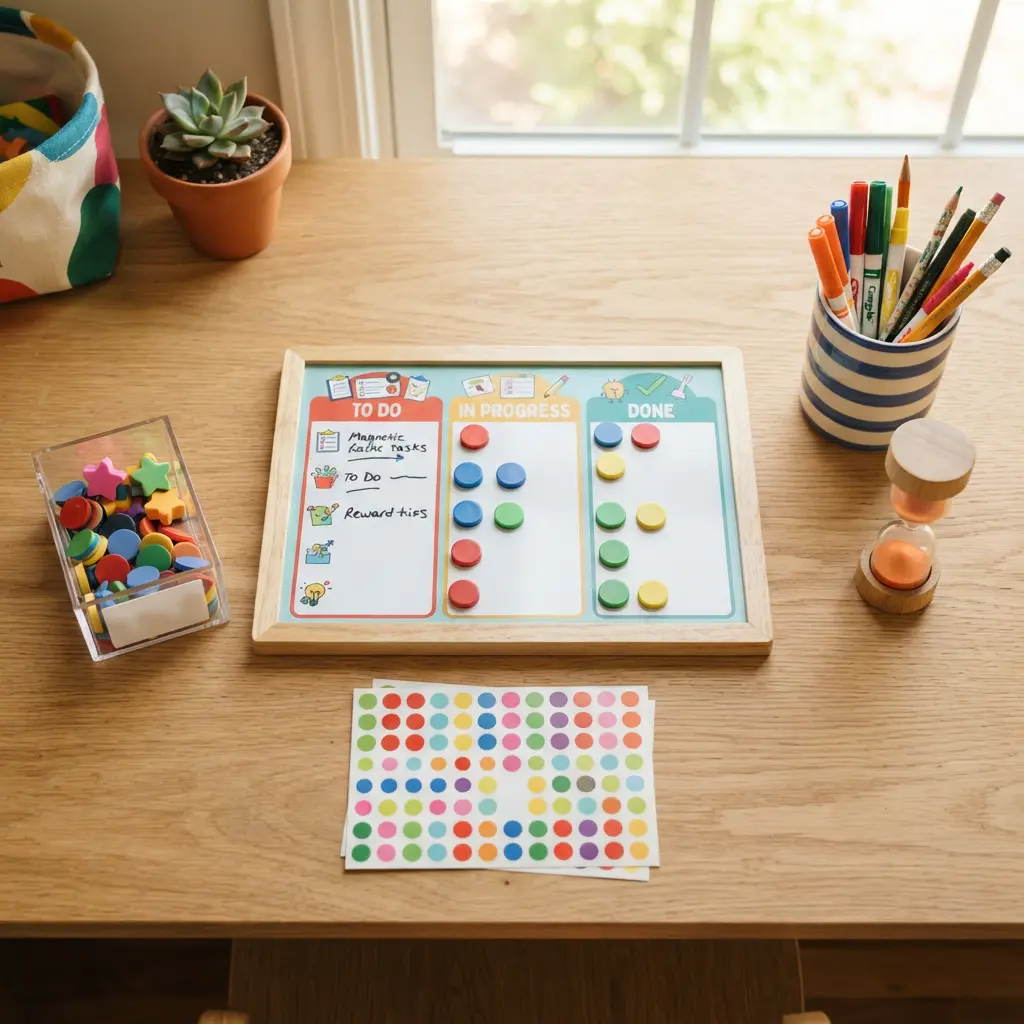
The Evening Routine Checklist can be a powerful tool here. When your child can see each step laid out in order, they stop relying on you to tell them what comes next — and you stop repeating yourself five times. That reduces friction for both of you.
The core principles of an ADHD-friendly evening routine include building in more transition time than seems necessary, keeping the sequence exactly the same every night, and making each step low-demand enough that it does not require a negotiation.

The Step-by-Step Routine That Actually Works
Here is a reverse-engineered routine built around the three obstacles covered above: delayed melatonin onset, arousal dysregulation, and transition resistance.
60 minutes before target bedtime: Screens off. Shift to a low-stimulation activity. This is not downtime — it is active decompression.
45 minutes before: Start the physical routine. Snack if needed, bath or shower, pajamas. Keep it calm and sequential. This is where the Bedtime Visual Schedule earns its place — your child follows the pictures, not your voice, which removes the power dynamic from the equation.
30 minutes before: Dim the lights in the bedroom. Dimming light signals the brain to begin melatonin release. This is one of the few "dim the lights" tips that actually has a mechanism behind it.
15 minutes before: Wind-down activity in the bedroom only. Reading aloud, an audiobook, or quiet drawing. No roughhousing, no exciting conversation about tomorrow's plans.
At bedtime: Brief check-in ritual — one or two minutes, consistent every night. This could be a question like "what was the best part of today?" It gives the brain a defined stopping point for the day.
Real example: Jordan's family tried this sequence after two years of bedtime battles with their nine-year-old. The first week was imperfect. By week three, Jordan was initiating the routine himself because the predictability had made it feel safe rather than punitive. His parents describe it as "not a miracle, but finally something that makes sense."
What to Do When They Cannot Stop Thinking
Even after a solid wind-down routine, many ADHD kids lie in bed with a busy mind. Thoughts race. They remember things they forgot to do. They worry about tomorrow. They call out for one more glass of water, one more question, one more anything.
This is sometimes called the "curtain call" problem, and it is not manipulation. It is a brain that cannot stop generating content.
A few strategies many families find helpful:
- Keep a notepad by the bed for your child to write or draw worries so they feel "parked" rather than lost.
- Try a simple body scan: ask your child to notice how their feet feel, then their legs, then their belly, moving slowly upward. This gives the busy brain a task.
- Use white noise or a simple nature sounds app to give the auditory system something neutral to process instead of ambient household noise.
- Stick to the same response every time they call out — calm, brief, and not engaging with content. Consistency matters more than the specific words.
The Tomorrow Preparation Checklist can also help here. When kids know their backpack is packed and their outfit is ready, they have fewer things to lie awake worrying about. Preparation is a sleep strategy, not just an organization one.
A Word on Melatonin
Melatonin comes up in almost every conversation about ADHD and sleep, and for good reason. Given that ADHD is associated with delayed melatonin onset, low-dose melatonin taken at the right time may help shift the body clock earlier.
But a few important things to know:
- Timing matters more than dose. Taking melatonin too late does not move the sleep window — it just adds a supplement that does nothing.
- Most pediatric sleep specialists suggest very low doses, often 0.5 to 1 mg, rather than the 5 or 10 mg doses sold in many stores.
- Melatonin is not a substitute for a wind-down routine. Research suggests it works best when paired with consistent behavioral supports.
- Always talk with your child's doctor before starting melatonin, especially if your child takes any ADHD medication, as interactions and timing can vary.
This is one area where a conversation with your pediatrician or a pediatric sleep specialist is genuinely worth having — not to get a prescription, but to get guidance specific to your child's situation.
When the Routine Is Not Enough
Sometimes families do everything right — consistent schedule, visual supports, screen limits, calm environment — and still face significant sleep problems. If your child regularly takes more than 45 minutes to fall asleep, wakes frequently in the night, or seems chronically exhausted despite adequate time in bed, that is worth mentioning to your doctor.
There are a few things that can complicate sleep in ADHD kids beyond routine alone. Stimulant medications taken too late in the day can delay sleep onset for some children. Sleep-disordered breathing, including mild sleep apnea, is more common in kids with ADHD than many parents realize. Anxiety, which frequently co-occurs with ADHD, can also be driving the bedtime battle more than the ADHD itself.
A solid routine is the foundation. But it is not the ceiling of what is available to you if you need more support.

Quick Action Plan
Here are four things you can do today to start shifting the bedtime dynamic.
- Set a screen-off alarm 60 minutes before your target bedtime and explain the reason to your child calmly, without framing it as a punishment.
- Print the Bedtime Visual Schedule and walk through it with your child before tonight — let them help you put it in order so they feel ownership over the routine.
- Pick one wind-down activity your child actually enjoys and designate it as the official pre-bed activity, starting tonight.
- Dim the lights in the bedroom 30 minutes before lights out. If you do not have a dimmer, a small lamp or nightlight in place of the overhead light works.
- Place a notepad by your child's bed and tell them it is for "brain parking" — anything they think of at night goes on the paper so they do not have to hold it.
- Use the Tomorrow Preparation Checklist after dinner so your child goes to bed with nothing undone creating background anxiety.
None of these require a major overhaul. Start with two or three and add from there.
Frequently Asked Questions
Why does my ADHD child get a second wind right at bedtime?
This is one of the most common complaints ADHD parents describe, and it has a biological explanation. The ADHD nervous system often produces a surge of alertness in the early evening — sometimes as a rebound effect when stimulant medication wears off, and sometimes simply as a feature of the delayed circadian rhythm common in ADHD. Trying to fight this second wind head-on usually backfires. Instead, starting the wind-down process before it hits — typically around 6:30 to 7 p.m. for school-age kids — can help prevent the spike from derailing the whole evening.
My child's ADHD medication seems to make bedtime worse. Is that normal?
It can be. Some stimulant medications have a rebound effect as they leave the system, which can temporarily increase energy or irritability in the early evening. Others, if taken too late in the day, may suppress appetite at dinner and then cause a hunger spike at bedtime. Some children do better with a medication timing adjustment or a different formulation. This is a conversation worth having with your prescribing doctor — it is a common issue and there are usually options to explore.
How long does it take for a new bedtime routine to work?
Most families see meaningful improvement within two to four weeks of consistent implementation. The first week is often the hardest because any change in routine can initially increase resistance in kids with ADHD before it decreases it. Consistency during that first week matters more than perfection. If you have been running the same routine without improvement after six weeks, that is a signal to look deeper — at medication timing, anxiety, or sleep disorders.
Is it okay to let my ADHD child stay up later on weekends?
A small shift of 30 to 60 minutes is generally manageable. A large shift — staying up two or three hours later and sleeping in dramatically — can reset the circadian rhythm in a way that makes Monday night very difficult. Many families find a modified schedule works better than a completely relaxed one on weekends, even if it feels strict. Think of it less as a rule and more as protecting the progress you have built during the week.

| Ready to make bedtime less of a battle? The strategies in this article work best when you have the right tools in hand from the start. The ADHD Parent Toolkit brings together everything you need, including the Bedtime Visual Schedule and the Evening Routine Checklist, in one place designed specifically for families like yours. Start with the Bedtime Visual Schedule tonight, let your child help set it up, and build from there. Small, consistent steps are what actually move the needle. |
|---|




Leave a Comment